21.03.2009

EUGENE DABIT ET HANS FALLADA

[liv apres.jpgarchives]

 EUGENE DABIT LECTEUR DE HANS FALLADA


 oOo


 Présentation : C'est tout à fait par hasard, en faisant des recherches sur le site Gallica de la BNF que nous avons retrouvé cette recension de « Et puis après ? » par Eugène Dabit. Eugène Dabit est surtout célèbre pour son roman « Hôtel du Nord » (Denoël, 1929), pour lequel il reçu le Prix du roman populiste, et qui fut porté à l'écran par Marcel Carné en 1938. Ce succès du roman « Hôtel du Nord » eu deux conséquences inattendues, aux effets conjugués, et sans lesquelles la littérature du XXe siècle aurait eu un tout autre visage :

  • - Louis Ferdinand Destouches commencera la rédaction de son roman 'Voyage au bout de la nuit' pensant y trouver un moyen de payer son terme. «J'ai écrit pour me payer un appartement... C'est simple: je suis né à une époque où on avait peur du terme! Maintenant on n'a plus peur du terme. Je me suis dit: c'est le moment du populisme. Dabit, tous ces gens-là produisaient des livres. Et j'ai dit: moi, je peux en faire autant! Ca me fera un appartement et je n'aurai plus l'emmerdement du terme!... Sans ça je ne me serais jamais lancé.» (1).
  • - En «raflant» à Gallimard Eugène Dabit et son «Hôtel du Nord», Rober tDenoël est enfin sur la bonne voie. Et ce succès «va lui apporter beaucoup plus : un vrai commanditaire, américain et riche de la fortune de sa mère. En avril 1930 est constituée la Société des Editions Denoël et Steele, au capital de 300.000 francs. Bernard Steele en fournit la moitié en numéraire, Denoël en marchandises, matériel, clientèle. Pendant deux ans ils vont publier des petits romans de débutants, des livres pour enfants, une collection d'ouvrages de psychanalyse, sans grands profits, jusqu'à ce qu'arrive le livre qu'attend tout éditeur, celui qui lance définitivement sa maison.»(2)

Remercions donc Eugène Dabit pour avoir été, même si indirectement, à l'origine d'une grande aventure littéraire.


Alain C. - 21 mars 2009

 EUROPE - N°141 - 15 septembre 1934
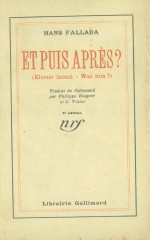
Recension de : HANS FALLADA. - Et puis après ? (N.R.F., édit.).

On comprend pourquoi le livre bizarre de Kafka : Le Procès, n'a pas connu un grand retentissement ; on s'explique moins la non-réussite d'un livre comme celui de Hans Fallada (non réussite, si l'on se prend à songer aux succès prodigieux de certaines traductions). L'histoire de Pinneberg et de sa femme « Bichette », c'est bien celle que peuvent connaître aujourd'hui, en France, des milliers de gens. Peut-être, de la vivre, cela les rend-il moins curieux d'apprendre quelle fut celle de leurs voisins allemands ? Il semble cependant qu'ils puiseraient dans cette œuvre quelque clarté sur le mauvais sort qui les guette.

L'histoire de Pinneberg et de sa compagne, ce n'est rien d'autre que la vie des employés de Paris, de ceux qui ne croient pas faire partie du prolétariat, qui prennent le métro à une heure différente des ouvriers, lisent d'autres journaux, s'habillent avec plus de recherche, parfois habitent d'autres quartiers ; mais qui, à leur insu, n'en subissent pas moins les mêmes lois. Le livre de Hans Fallada pourrait leur ouvrir les yeux ; il coûte 15 francs, le prix de deux ou trois séances de mauvais cinéma - mais peut-être ne veut-on connaître que de médiocres rêves ? - Bref, Pinneberg, c'est un vendeur d'un grand magasin de confection berlinois (après avoir été comptable, en province). Il doit, comme tout vendeur, avoir de bonnes manières, un langage fleuri, et surtout faire journellement son chiffre d'affaires, un chef de rayon est là pour le lui rappeler. Hors de ses heures de service, il ne doit pas davantage oublier qu'il appartient à la maison Mandel. Non ? « C'est ce qui vous trompe, dit à ce propos le directeur. La maison Mandel vous nourrit et vous habille, c'est elle qui vous permet de vivre. Nous avons le droit d'attendre de vous que, dans tout ce que vous faites, vous pensiez d'abord à la maison Mandel. » Voilà. A Paris, comme à Berlin. Et dame, par ces temps de chômage...

Ce n'est pas seulement ce métier de vendeur, avec ses roueries, ses servitudes, qui nous est montré ; mais, plus parfaitement, plus profondément, l'existence d'un ménage berlinois, de ceux qu'on appelle, à Paris : français moyens, hommes de la rue, ou en littérature : personnages populistes. Oublions ces étiquettes. Hans Fallada nous raconte par le menu les gestes et les pensées de ses deux jeunes héros. Ils s'aiment, c'est leur seul vrai bonheur ; puis ils ont un gosse, qui ne diminue point ce bonheur. Au-delà de ce cercle ce n'est qu'inquiétudes, tourments, horizon noir. L'auteur n'a pas choisi de nous montrer ses héros dans des circonstances dramatiques, la vie quotidienne l'est assez, qui exige peut-être le seul vrai courage, silencieux, anonyme. Cela est admirablement senti, exposé, développé, dans cette œuvre. Pas de gémissements, pas de cris, pas de révolte. Mais si Pinneberg et sa femme se débattent d'une façon qu'on ne peut appeler grande ni courageuse, ils n'en sont pas moins, peu à peu, il est vrai, conscients de leur destin ; et plus émouvants de ne point désespérer d'une vie que des hommes leur ont rendu si précaire et si morne. Le livre entier n'est rien d'autre que le compte-rendu presque journalier de cette vie. On fait son budget, on l'équilibre, de l'imprévu bouleverse vos calculs ; on voudrait s'acheter un manteau neuf, mais il faudra attendre encore plusieurs saisons ; se passer un caprice, alors il faudra se priver de viande ; avoir du beurre... et le loyer ? Un sou est un sou. On imagine que cela ne permet pas de grandes envolées. C'est l'existence que mènent des milliers d'êtres, ceux qu'on appelle les humbles, les petites gens, et qui sont des hommes ; une existence que pourtant ils souhaitent voir durer. Oui, Pinneberg et sa Bichette ne font pas de plus beaux rêves. Mais ce n'est là qu'un rêve. Un mois vient où Pinneberg ne réalise pas son « chiffre », où il commet quelques maladresses, il est renvoyé, il doit faire tamponner sa carte de chômage. Un soir, dans une des rues luxueuses de Berlin, tristement, il erre...

« Et soudain, devant cette vitrine, devant ce Schupo, devant ces honnêtes gens, Pinneberg comprend tout. Il comprend qu'il est en trop, que sa place n'est plus ici, qu'on le chasse à bon droit : il n'a plus qu'à disparaître. L'ordre et la propreté : c'était pour autrefois. Le travail et le pain assuré : c'était pour autrefois. Faire son chemin et espérer : c'était pour autrefois. La pauvreté n'est pas seulement misérable, la pauvreté est coupable, la pauvreté est dégradante, la pauvreté est suspecte. » Un Schupo le frappe, Pinneberg rentre chez lui en sanglotant. « Oh, Bichette, bégaye-t-il, qu'est-ce que qu'ils on fait de moi... les Schupo... ils m'ont poussé du trottoir, ils m'ont chassé. Comment puis-je encore regarder quelqu'un ? » - « Mais tu peux me regarder, murmure Bichette. Toujours, toujours ! »

Le livre se termine ici. Ce que fut la vie de demain, l'avenir de Pinneberg et de sa femme, Hans Fallada nous le laisse à deviner. Aujourd'hui ressemble à hier ; aujourd'hui, encore, c'est l'hitlérisme, et pour des Pinneberg, après tant de duperies, de nouveaux mensonges, brillants, sonores exaltés, qui leur feront accepter l'idée d'une guerre comme le seul avenir possible. Il est vrai que la mort est au bout, vite, et ça c'est un avenir sûr.

Je ne sais si le livre de Hans Fallada est un grand livre, mais je souhaite à chacun de le lire. Sans doute n'a-t-il point les richesses qu'on désire trouver dans un grand livre. Il s'agit de richesses d'ordre littéraire - d'ailleurs, la traduction ne nous laisse pas, hélas, deviner la saveur, la bonhomie, la malice, et le charme de l'esprit de Hans Fallada. Mais on ne songe jamais trop vivement qu'elles font défaut tant on approche de près l'existence d'un couple dont le malheur se répète indéfiniment sur une partie de ce monde.


Eugène DABIT


Notes :

  • (1) - entretien avec Madeleine Chapsal, L'Express n°312, 14 juin 1957, pp. 15-18. Repris dans Madeleine Chapsal, Les écrivains en personne, Paris, Julliard, 1960 pp. [73]-93, ainsi que dans Cahiers Céline, 2, nrf, Paris, Gallimard, 1976, pp. 18-36.
  • (2) In Henry Thyssens: Robert Denoël, un cinquantenaire oublié, sur le site consacré à Louis Ferdinand Céline (lien). Sur Robert Denoël, on consultera le site très riche que lui consacre Henry Thyssens: Robert Denoël, Editeur.

08.03.2009

Unlucky Hans

 http://www.thenational.ae/article/20090116/REVIEW/8007...

Unlucky Hans

[from The National (see link above) : January 16. 2009

Hans Fallada spent his life nervously vacillating between rebellion against and co-operation with Nazi rule. But just before his death, Sam Munson finds, he wrote the great novel of German resistance.

To the exquisitely cultured 21st-century reader, Primo Levi’s endorsement of a first-rate thriller as “The greatest book ever written about German resistance to the Nazis” might seem improbable. German literature has a well-deserved reputation for formal and philosophical difficulty. The names that English readers most quickly recognise – Thomas Mann, Alfred Döblin, Günter Grass – have come to be almost synonymous with a vision of the novel as an uncompromising, compositionally demanding object, one that makes little concession to its reader. The German canon is no place for thrillers.

But Levi is right. Every Man Dies Alone, the German novelist Hans Fallada’s final book (now available for the first time in English, in a fluid translation by Michael Hofmann), deserves a place among the 20th century’s best novels of political witness.

The story of the novel’s genesis is as dark as the book itself – and its author’s trouble-heavy life. Fallada, a writer of closer stylistic kinship to Graham Greene than to Günter Grass, was born Rudolf Ditzen in 1893. He began his literary career as an outsider, a transplant to Berlin from the provinces with a passionate interest in European literature, a youthful suicide attempt in his past and a string of drug-related arrests on his record (Fallada suffered from morphine addiction for much of his adult life). In 1932, he produced his first best-seller, Little Man, What Now?, the story of a working-class marriage set in the last days of the Weimar Republic.

Two years later, his next novel, Once We Had A Child, brought him to the unfriendly attention of the Nazi authorities for its deviation from the party line on family life. The remaining 14 years of Fallada’s life were spent vacillating unhappily between rebellion against and co-operation with Hitler’s regime. He planned to leave Germany; he abandoned the plans. He wrote forewords to his own novels aimed at placating the authorities by suggesting that, when read correctly, they did not actually contravene government policies. For a time he avoided serious literature, writing humour books and children’s stories. Then he agreed to produce an anti-Semitic novel for Hitler’s propaganda minister, Joseph Goebbels. But during his subsequent incarceration (for domestic violence) in a psychiatric hospital, he used Goebbel’s (somewhat uncertain) backing to procure pen and paper and produce The Drinker – a piercing novel of alcoholism (one of Fallada’s own vices) and social decay, and surely no piece of agitprop.

Fallada was released in December 1944, just months before the Nazi government fell. Shortly thereafter, one of his friends got him a copy of the Gestapo file on Otto and Elise Hampel, a middle-class couple who had embarked on a dangerous and ultimately pointless leafleting campaign against the government. Working from this material, Fallada – his mental and physical health failing, his family life irreparably damaged by his alcoholism and his political status – wrote Every Man Dies Alone.

The book’s protagonists (they are certainly not heroes) are Otto and Anna Quangel, a factory foreman and his wife. Otto is congenitally silent, Anna pathologically generous of spirit. They have an uneventful marriage; a son, Ottochen, at the front; and a soon-to-be-daughter-in-law, Trudel, at home in Berlin. When Ottochen dies at the front (or “falls”, as the argot of the Hitler years had it), Truden collapses at the news, and Otto breaks his long-running silence. Though he helped vote Hitler into power (“It was true, thus far he had been a believer in the Fuhrer’s honest intentions. One just had to strip away the corrupt hangers-on and parasites”), Otto finds himself disenchanted with the government’s war-making abroad and repression at home. He begins a propaganda campaign against the regime, writing out anti-Hitler postcards by hand and depositing them around Berlin. Anna, who had already taken her own small steps towards resistance by sheltering a Jewish refugee for a single night (much to Otto’s anger), is impressed by her husband’s new expressiveness and, like him, driven to act by Ottochen’s death.

Together they scatter postcards and evade the Gestapo for months, causing hilarious internal strife at the security offices on the Alexanderplatz. Eventually Otto fumbles a card en route to a drop, and he and Anna end up in the hands of the security apparatus. Otto is sentenced to execution by the People’s Court (Nazi Germany’s central organ of extra-judicial public punishment), and he dies by guillotine in a dark, stifling basement. Anna, awaiting her own execution date in Berlin’s Old Moabit Prison, dies in a bomb blast during one of the British bombing runs.

Partisans, whether they hide in a forest with guns or drop postcards in Berlin apartment houses, are supposed to win. Even when they do not, we expect them to possess any number of romantic attributes. The Quangels, however, are boring, morally dubious people. Otto, after all, had been an early supporter of Hitler, if not a party member; Anna’s existence is more or less untouched by political conviction; and the two managed to live for years without the slightest inclination to obstruct their government (Anna’s night of refugee shelter aside). But even as passive a character as Otto can be forced to wakefulness by history:

No, he says to himself, almost aloud. No, Quangel, you’ll never be the same again. I’m curious what Anna’ll have to say to all this... Foreman Otto Quangel walks alertly from machine to machine, takes a hand here, glowers at a chatterbox there, and thinks to himself, That’s the end of that, for good and all. And they haven’t got a clue. As far as they’re concerned, I’m just a doddery old fool... I wonder what I’m going to do next. Because I will do something, I know. I just don’t yet know what it will be ...”

Fallada interweaves the tale of this failed resistance movement – which he paints as almost senseless, eccentric and foredoomed – with those of the lives affected, directly and indirectly, by the Quangels’ decision: Trudel (their deceased son’s fiancée); Emil Borkhausen, a neighbour of the Quangels’ and a petty criminal who, with his partner Enno Kluge, robs an Aryanised apartment in the Quangels’ building; the tenacious, soulless Inspector Escherisch, the policeman assigned to capture the Quangels, whose failure to do so lands him in prison and who only finds a measure of redemption after his release – through suicide. Almost every character Fallada introduces to us dies, most of them at the hands of the government. Fate is blind and cruel in this book, and fear is the definitive component of German life. The Nazi bureaucracy – in which suffocating, indecipherable organisational codes and casual brutalities merge and thrive – possesses the same frightening omnipresence of the city government in Kafka’s The Trial. Readers of Every Man Dies Alone, however, cannot succour themselves with the thought that these officers, these prisons, this justice, are works of the author’s imagination.

The book’s treatment of the Gestapo is perhaps the ultimate source of its particular greatness. The archetypal German literary work of the war years, for good and ill, is Thomas Mann’s Doktor Faustus: the story of a musician seduced by the dionysian attractions of his art (and, obliquely, of a nation seduced by the power and dark glory of Manichean political evil). Layered with discussions of music theory and theological history, Doktor Faustus is, in short, a novel of metaphysics, not a novel of grim particularity. Thus it neglects the dismal everyday that Fallada chronicles so well and so relentlessly: the quantities of booze drunk by the miserable officers, the number of blows delivered in interrogations, the dimensions of prison cells, the colour and details of police and military uniforms, train schedules, back room low-level party meetings. Where Mann might use the police headquarters on the Prinz Albrecht Strasse as a chance to explain the dialectic between modern and medieval German architecture, Fallada sees only petty human evil in action:

They caught hold of the still-staggering Borkhausen and slung him down the stairs like a sack of potatoes, tumbling over and over... The next sentry grabbed him by the scruff of his neck and screamed ‘You think you can dirty our nice floor here, you pig!’ dragged him to the exit, and heaved him out into the street... The passersby on the Prinz Albrecht Strasse studiously avoided looking at the man sprawled in the dirt...”

That Fallada discerned in all this, and in the brief rebellion and deaths of the Hampels, fit material for a novel demonstrates a piercing psychological acuity. So does his prose, which hurries mercilessly along, bald and frank as time itself:

“‘I’ll throw you in the water, son of a bitch. And it’ll be self-defence...’ Two shots rang out, in quick succession. The Inspector felt the man crumple between his fists, and topple over. Reflexively, Escherisch made a move as he saw the dead man slip off the edge of the pier. His hands wanted to grab hold of him. Then with a shrug the Inspector watched as heavy body smacked into the water and straightaway disappeared.

Better that way! He said to himself, as he moistened his dry lips. Less evidence. . . He walked slowly back down the pier, up the bank of the lake towards the station.

The station was locked, the last train was gone. Indifferently, the Inspector set off on the long walk back to Berlin.

The clock struck.

Midnight, thought the inspector. He made it to midnight. I’m curious how he’ll like his peace, really curious. Wonder if he’ll feel cheated again? The piece of s***, the whimpering piece of s***.”

Mann’s impulse to metaphysics – to view the catastrophes of one’s own age and the eruption of subterranean human desires primarily as philosophical or aesthetic events – appears in a plurality, if not a majority, of 20th century German fiction, in writers as varied as Arno Schmidt and Alfred Andersch. In On the Natural History of Destruction, a brilliant collection of essays on postwar German literature, the novelist WG Sebald deems this tendency useless, insufficient — even “dubious”, as he puts it in his discussion of Schmidt.

In Sebald’s opinion, witness to the horrors of the war, and in particular the horrors of the camps, demands something else entirely: books of brutal, surgical clarity, the better to express and confront the cataclysmic, a state of being that became quotidian for Germany’s victims. Sebald cites the work of the novelist Hubert Fichte; better known entrants in this field are Levi’s Survival in Auschwitz, Tadeusz Borowski’s This Way for the Gas, Ladies and Gentlemen, Imre Kertész’s Fatelessness.

Sebald’s diagnosis is more accurate than not; thus we don’t typically think of effective books of witness being written by Germans who had ambiguous relationships with the Nazis. But Fallada did write such a book – in the seemingly-impossible span of 24 days, after which he died. It is telling that he took his pen surname from a figure in The Goose-Girl, one of the fairy tales collected by Jakob and Wilhelm Grimm: Fallada, a hapless talking horse so bent on revealing the truth that decapitation failed to silence him.

Sam Munson has written about books for The Times Literary Supplement, The New York Times Book Review, Commentary and numerous other publications.

Back with a Bang !


March 8th, 2009

Good evening,

There is a high press coverage after the recent publication of "Everyone Dies Alone" (US) / "Alone in Berlin" (UK). We posted on that site some of the reviews of the book which are, to our opinion, the most interesting ones... We cannot mention all of them, sorry.

Use your own research engine and I'm pretty sure you will find more about the book

Any reader who had read the book and can give us more details about the « Melville House edition » which includes some extras (the couple's mug shots and selections from their Gestapo file and from trial transcripts as well as some of the anti-Reich postcards they distributed) would be welcome.

Alain C.

Postcard from the Edge

From : http://www.nytimes.com/2009/03/01/books/review/Schillinge... 

Postcards From the Edge

Published: February 27, 2009 

A signal literary event of 2009 has occurred, but if publishers had been more vigilant, it could have been a signal literary event in any of the last 60 years. This event is the belated appearance in English of the novel "Every Man Dies Alone," the story of a working-class Berlin couple who took on the Third Reich with a postcard campaign intended to foment rebellion against Hitler's Germany. Published in 1947, the book was written in 24 days by a prolific but psychologically disturbed German writer named Rudolf Ditzen, who spent a significant portion of his life in asylums (for killing a friend in a duel, for threatening his wife with a gun), in prison (for embezzling to finance his morphine habit) and in rehab. In spite of his precarious emotional state, he wrote more than two dozen books under the pen name Hans Fallada, which he took from Grimm's Fairy Tales.


Courtesy of Uli and Achim Ditzen
Hans Fallada in 1934.

Falada was the name the Brothers Grimm gave to a slaughtered horse in the story "The Goose Girl," whose head, nailed on a city gate, speaks to its former mistress, a princess who had been betrayed by her servant. The king of the realm, overhearing the talking head, rights the injustice that caused the horse's death. (Fallada added a second "l" to make the name his.) "Hans" he took from the Grimm tale "Hans in Luck," about a man who mistakes his bad luck for good and is contented, let the world jeer as it may. The pen name fulfills its prophecy. Rescued from the grave, from decades of forgetting, this novel, first published just weeks after the author's death, testifies to the lasting value of an intact, if battered, conscience.

Fallada's novel takes place in wartime Berlin. Early in 1941, half a year after the French capitulation to Germany, a Gestapo inspector named Escherich stands in his office on Prinz-Albrecht-Strasse, contemplating a map of the city into which he has stuck 44 red-flagged pins. Each marks a spot where a different inflammatory postcard has been found - "Hetzkarten" that denounce Hitler, hand-written in heavy, clumsy print. The first card reads: "Mother! The Führer has murdered my son. Mother! The Führer will murder your sons too, he will not stop till he has brought sorrow to every home in the world."

Inspector Escherich's job is to locate and stop the distributor of the cards, using the pins as a chart of his movements. Will the "postcard phantom" be found? Escherich's life depends on it; the brutish Obergruppenführer Prall who oversees his activities makes no mystery of that. A terrified populace ensures that the red-flagged pins will continue to be turned in to the authorities. The "phantom" by necessity must live among other people - in a certain building, on a certain street, in a certain neighborhood - during a time when "half the population is set on locking up the other half" and any unusual (or usual) behavior can be reported by neighbors intent on saving their own skins. ­Every man may die alone, but nobody lives alone, or entirely unobserved.

The "phantom" turns out to be a quiet, cautious, middle-aged couple, Otto and Anna Quangel. The building they live in also houses a timid Jewish grandmother whose husband has been arrested, a bookish judge and a bestial Nazi family. Other characters pass through, from mail carriers, housekeepers and policemen to an opportunistic thug and a whiny drifter,as well as the Quangels' prospective daughter-in-law. Quangel, a taciturn factory foreman, has always kept to himself, using a shield of surliness to ward off any person but his wife, any activity but his work. He has neither joined nor defied the Nazi Party. But when he learns that his only son, who never wanted to be a soldier, has died at the front, Quangel is shaken from his passivity, inspiring the postcard plot. When his wife protests that this resistance is too inconsequential to make a difference, he retorts, "Whether it's big or small, Anna, if they get wind of it, it'll cost us our lives." "He might be right," she concludes. "No one could risk more than his life. Each according to his strength and abilities, but the main thing was, you fought back."

The Otto and Anna Quangel of Fallada's novel are stand-ins for real-life Berliners, Otto and Elise Hampel, a working-class couple who conducted a postcard campaign for more than two years at the height of Hitler's power, after Elise's brother was killed in the war. Arrested in October 1942, they were sentenced to death by the Volks­gerichtshof (People's Court) in January 1943 and executed by beheading. Their Gestapo files came into Fallada's hands in the fall of 1945, entrusted to him by a poet and postwar culture official, Johannes Becher, who knew of Fallada's prolific literary output and recognized his gift for objective narration.

In a publishing hat trick, Melville House allows English-language readers to sample Fallada's vertiginous variety - and understand Becher's faith in him - by accompanying the release of Michael Hofmann's splendid translation of "Every Man Dies Alone" with the simultaneous publication of excellent English versions of Fallada's two best-known novels, "Little Man - What Now?" (translated by Susan Bennett) and "The Drinker" (translated by Charlotte and A. L. Lloyd).

In "Little Man - What Now?" (first published in Germany in 1932), a white-­collar salesman named Pinneberg and his ­working-class bride try to find employment in Berlin, but their fortunes are ruined by the global depression. (Imagine a Horatio Alger novel in which the humble hero fails.) When a policeman bullies Pinneberg - jobless, collarless and nearly pfennigless - as he stares into the window of a fancy delicatessen, he realizes he has fallen off the grid: "He understood that he was on the outside now, that he didn't belong here anymore, and that it was perfectly correct to chase him away. Down the slippery slope, sunk without trace, utterly destroyed."

"Little Man - What Now?" became an international hit, translated into more than 20 languages and filmed in both Germany and the United States in the first years of the 1930s. Today its pathos lives on chiefly in the tender song "Kleiner Mann - Was Nun," by a Weimar-era choral group called the Comedian Harmonists, who sang it together onstage until they were banned from performing (a year and a month after the burning of the Reichstag) because half their members were of Jewish descent. In his probing afterword to "Little Man - What Now?" Philip Brady ponders the question of why the book isn't better known today: "Enduring success is one thing, immediate impact is something different, and clearly the immediate impact of Fallada's novel was undeniable." Given our current economic ­circumstances, the book may have a second chance at impact and endurance.

"The Drinker," which Fallada wrote in 1944 while he was locked up in a criminal asylum for attacking his estranged wife, is a memoirish novel in which a country merchant describes his unrepentant, gloating slide into alcoholism and failure. Erwin Sommer, who has come to hate his wife, Magda, for her business acumen, starts drinking himself senseless, takes up with low company, steals the family savings, threatens to kill Magda and is institutionalized. In the asylum, vain and obdurate, he abases himself like a Karamazov, rolling in the muck he has made of his life, yet putting on airs to the end. "You're an easily offended man, Herr Sommer," a doctor tells him. "But I must tell you quite frankly that in your marriage, your wife is the guiding hand, the superior partner." He urges Sommer to let himself "be sheltered and guided" by her. The words infuriate Sommer: "I could not forgive his remarks about Magda's superior efficiency."

Fallada's books generally recapitulated his personal history, from "Young Goedeschal: A Novel of Puberty," a youthful effort he later disowned, to "Farmers, Functionaries and Fireworks," a fictionalized account of a conflict between rural workers and greedy authorities in Schleswig-Holstein (he covered the dispute while working as a reporter), to the three novels discussed here. "Every Man Dies Alone" stands above these others, perhaps because so many of the circumstances it enfolds lie outside Fallada's firsthand experience, forcing him to harness his empathy and broaden his focus. And yet the novel he wrote about the Hampels reads less like fiction than like an act of witness: a reincarnation of their world, a posthumous tribute to their sacrifice.

But what can be made of the author himself? An enigmatic, complicated figure, Fallada has been the subject of a handful of biographies in German. The fascinating scholarly afterwords contributed to "Little Man - What Now?" by Philip Brady and to "The Drinker" by John Willet retrace the author's life and work, and weigh his contribution. They acknowledge that the critics of Fallada's own era praised him for his "authenticity" and well-drawn characters but questioned his imaginative powers, often dismissing his writing as unpolished or workmanlike - as, in short, an overly literal interpretation of the New Objectivity (Neue Sachlichkeit) that overtook German arts and letters in the 1920s and '30s in revolt against abstraction and expressionism. But at the remove of more than half a century, Fallada's reanimation of the actions, motivations and private terrors of Berliners who are long since dead - leaving a full record of wickedness and, sometimes, goodness - is infused with something else. Call it Alte Sachlichkeit: the reality of another age, restored.

According to Brady, the author once admitted that he "could depict only what he saw, not what might happen." What Fallada saw in Berlin in the 1940s was enough to make a weaker man close his eyes. But Fallada kept his open. He was not strong enough to leave Nazi Germany, although he was given the chance. But he was strong enough to record what he saw. "From the minute I sit down and write the first line," he once explained, "I am lost, a compelling force is in command. That force dictates just how and how much I must write, whether I want to or not, even if it makes me ill. . . . A hundred times I have wondered what it is that drives me so." It was as if he had no choice. On another occasion, he compared his need to write to an "intoxication," like the morphine he once craved. He called it "a poison that I could not shake out of my mind or my body, I was thirsty for it, I wanted to drink more of it, to drink it always, every day for the rest of my life."

The appearance of these three books in English brings to a wider audience the keen vision of a troubled man in troubled times, with more breadth, detail and understanding (if not precisely sympathy) than most other chroniclers of the era have delivered. Perhaps Lucky Hans was strong­er than he knew: rich in his misfortunes. To read "Every Man Dies Alone," Fallada's testament to the darkest years of the 20th century, is to be accompanied by a wise, somber ghost who grips your shoulder and whispers into your ear: "This is how it was. This is what happened."


Liesl Schillinger is a regular contributor to the Book Review.

Related First Chapter: 'Every Man Dies Alone' (March 1, 2009)

The Long War

http://www.nextbook.org/cultural/feature.html?id=3285

The Long War

A 1947 novel about German resistance to the Nazis finally appears in English

by Matthew Shaer

 In the late summer of 1944, the German novelist Hans Fallada was committed to a Nazi psychiatric prison in Strelitz-Alt, some 70 miles north of Berlin. The timing-if not the disagreeable circumstances of Fallada's incarceration-was propitious. By the end of August, the Red Army had secured Bucharest and was hurtling towards Poland; to the west, U.S. forces were amassing along Germany's western border. The Nazi leadership, fearing the worst, issued a directive calling all able-bodied men under the age of 60 to the front.

Fallada, born Rudolf Ditzen, was saved both from the indignity of service, which surely would have killed him, and the aftermath of a particularly calamitous divorce. On the evening of August 28, the 51-year-old novelist drunkenly set upon his first wife, Suse, with a loaded pistol. He got off only one errant shot, in the general direction of the kitchen wall, before Suse grabbed the gun and used it to crack Fallada sharply on the skull. She disposed of the weapon in a nearby lake, and a local prosecutor sentenced Fallada to an indefinite term at Strelitz.

The horrors of that prison were manifold. But Fallada had been behind bars several times over the course of his life-first in 1912, after killing his best friend in a botched double-suicide-and seems to have found a modicum of comfort at Strelitz. He temporarily shook the alcoholism that had dogged him his entire life, and eventually he was granted a request for writing materials. Officially, Fallada assured his captors that he intended to finish a state-sanctioned book on a 20-year-old fraud case against a group of Jewish financiers. The Barmat Scandal had helped fan the flames of anti-Semitism in Weimar Germany, and Joseph Goebbels was keen on its revival.

In a letter dated June 1943, a representative of the Propaganda Ministry offered Fallada full "support" if he made the Barmat project a "priority." This was no small insurance at a time when German intellectuals and writers struggled under an intensifying campaign of persecution. As Jenny Williams writes in her 1999 biography, More Lives Than One, Fallada probably had in mind a "survival strategy." He would agree to write the book to Nazi specifications, but stall production until the war had ended.

Fallada was no anti-Semite. His fiction is noticeably solicitous of German Jewry-a fact that had not escaped the attention of the Nazi censors on previous occasions-and he counted among his circle of friends Jewish writers and critics. He was a humanist, but also a pragmatist, and he later dismissed "enterprises such as conspiracies and coups d'etat" as "ridiculous." The ruling powers were too strong, he told himself, and the evil too corruptive. He aimed to pursue a subtler path of defiance.

'Every Man Dies Alone' cover

Over the stretch of September 1943, Fallada began painstakingly filling pages of prison paper with tiny script, often in cramped, circuitous patterns. He eventually completed a small canon of work: a deeply anti-fascist memoir of his life under the Nazis, a series of short stories, and a great novel of addiction, The Drinker. In the margins of one sheet he wrote:

Every ten minutes or so a guard comes into my cell, looks curiously at my scribblings and asks me what I am writing. I reply, "A children's story," and continue writing. I dismiss from my mind all thoughts of what would happen to me if anyone reads these lines.

Fallada was not caught, and in October he walked out the doors of the prison with the 184-page manuscript stuffed under his shirt. A few months later, he married a stunning 22-year-old named Ulla Losch, and when the Russians swept through Germany, Fallada was named mayor of the town of Feldberg. But he was a man unhinged, and public allegations of collaboration and political "opportunism"-this last volley from a former typist-hurt him badly. He slid with Ulla into a mutually enabling morphine addiction, and finally expired in 1947, shortly after finishing his masterpiece, Every Man Dies Alone.

What now to make of such a relatively brief and singularly tortured career? Was Fallada a collaborator and a coward, or was he-as he framed it later in his life, once the Nazis had been safely deposed-a writer crushed under the heel of history? Three books being published next week by Melville House offer a clue. The first is Little Man, What Now?, Fallada's melancholy evocation of poverty in the run-up to war; the second is The Drinker. Both titles have appeared before in English, and the former was the basis for a 1934 Hollywood movie. (The film, which was backed by Jewish producers, apparently caused Goebbels much consternation.) The third, Every Man Dies Alone, appearing for the first time in English, is the real discovery here, and arrives handsomely packaged with a cover blurb from Primo Levi: "The greatest book ever written about the German resistance to the Nazis."

'Little Man, What Now?' cover

Resistance! The word seems to promise the modern reader the clamor and catharsis of an armed uprising, perhaps in the mode of Levi's own novel, If Not Now, When? And yet the resistance Fallada evokes in Every Man is distinctly small-bore-small enough, in fact, that by the end of the narrative, one of the characters, languishing in Gestapo headquarters, can plausibly wonder aloud, "So I've accomplished nothing?"

The book is based on a propaganda campaign waged by a pair of Berliners, Otto and Elise Hempel, who were eventually captured by the Gestapo, and executed in Plötzensee Prison in 1943. Uneducated and poor, but possessed by a fiery rage against the Nazi regime, the Hempels over a three-year period carpeted their city with postcards calling for a working-class uprising. Fallada was given the Hempels' Gestapo file by a friend in the postwar ministry, and although he claimed initially to be uninterested in the case, he eventually took to its fictionalization with fervor.

In Fallada's telling, Otto and Elise Hempel become Otto and Anna Quangel and the postcard scheme is rendered as allegory-the conscience of a crushed populace, burbling up from the tenements and the factories. Small-scale acts of rebellion abound. An old judge in the Quangels' building takes in Frau Rosenthal, a Jewish neighbor; an aging widow helps protect a lover from the Gestapo; a "cell" of dissidents is assembled and than disbanded. Otto and Anna are largely disconnected from this larger political current. Their postcards condemn oppression-they distribute one card decrying the "persecution of the Jews"-but they remain intentionally oblivious even to the plight of Frau Rosenthal, who hurls herself out of her apartment window, to her death.

'The Drinker' cover

In an essay translated by the Australian scholar Geoff Wilkes, who contributed an afterword to the new edition of Every Man, Fallada writes of the Hempels: "As many lonely people, just like many simple minded people, these two (earnestly, without fantasy) believed that they experienced something unique, what happened to them had not happened to anyone else." Not so for the Quangels. The fictional couple are aware that others are suffering, and Anna early on wonders at the possibility of pursuing something grander, like an "attempt to assassinate the Fuhrer." The postcards strike her then as an "obscure and ignoble form of warfare." Only after much consideration does she settle into the "long war," for "she, too, has become patient."

From the comfort of the 21st century, we buck against the notion-how could anyone be patient with so much at stake? But Fallada suggests that morality under Nazi rule was not measured by the size of the struggle; it mattered only that one did not capitulate. Or, more specifically, that one did not betray oneself. As one character tells Otto, after the Quangels have been caught and imprisoned:

At least you resisted evil. You did not become evil. You and I and the many people here in this building and many, many more in other prisons and the institutions and the thousands in concentration camps-they are all still resisting, today, tomorrow . . . . 

And therein a mild plea of acquittal. Like many of his countrymen, Fallada was taken by surprise by the violence of Hitler's rise to power, and for much of the war, he remained at his farmhouse in Carwitz with his family. Jenny Williams argues that that Fallada's longstanding and "natural inclination was to run away from unpleasant situations."

That is certainly correct, but on several occasions, Fallada actively sought to placate the authorities. He twice toured the French front on the request of several high-ranking officials, and he revised some of his best work to suit the censors. In 1934, he attached a new foreword to a book called Once a Jailbird, causing Thomas Mann to remark wryly that "in order to be published in Germany a book has to disown and deny its humane philosophy in an introduction."

Of course, unlike Mann, Fallada never left Germany. Officially, he said he loved his country too much. Unofficially he appears to have been worried he might suffer a massive nervous breakdown. Fallada had battled since childhood with mental illness and addiction; his best fiction bears the evidence of deep psychic scarring. "I know I'm weak," Fallada wrote in a final letter to his mother, "but not bad, never bad. But that's no excuse, it's poor enough to at 53 to have become nothing more than a weak man."

One feels for Fallada, while remaining slightly suspicious of his resolve. He knew the extent of the destruction unfurling around him, but failed to raise a single finger in protest. And yet the very act of writing Every Man Dies Alone-to say nothing of the stunning political clout of the novel itself-implies that for Fallada, the artist's true role under fascism was chiefly one of bearing witness. The German people "only recognize the reality they see with their own eyes, not what they are told," Fallada once told a fellow writer. "It is the politicians' job to subordinate themselves to reality. It is the artists' job to describe that reality the way it is."

Matthew Shaer has written about books for the Los Angeles Times, the Boston Globe, the Village Voice, and the Christian Science Monitor, where he is a staff writer.

Toutes les notes