25.10.2009
Hans Fallada : calme plat ?
Bonjour,
L'actualité est relativement calme autour de Hans Fallada. Le monde anglophone a connu une grosse activité à partir de la fin du premier trimestre, avec la parution simultanée aux Etats-Unis d'Amérique et en Angleterre de la traduction de "Jeder Stirbt für Sich Allein".
Saluons la version chez Melville House Publishing, augmentée de 32 pages comprenant :
une postface de Geoff Wilkes
un essai intitulé "The True Story Behind Every Man Dies Alone"
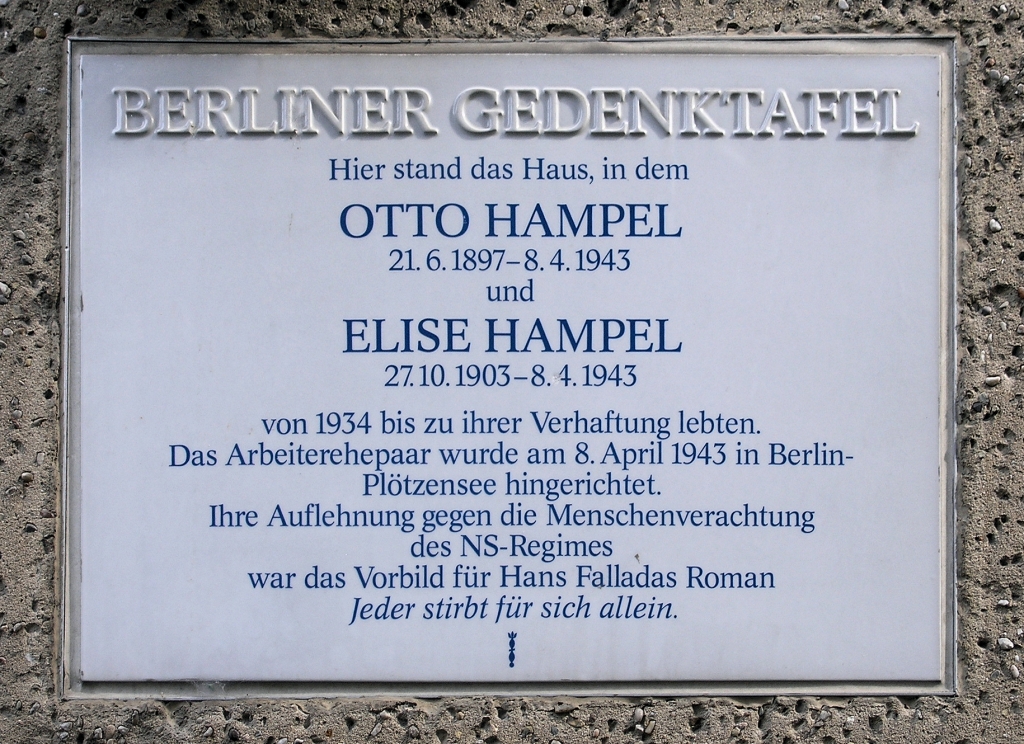
le dossier original de la Gestapo, incluant des photos des Hampel, des cartes postales qu'ils écrivirent et de leur aveux signés
Le pages intérieures de la jaquette représentent une carte en couleur de Berlin, dûment annotée.

Sinon, vous avez remarqué que nous avons publié une modeste traduction du texte "Vom Entbehrlichen und vom Unentbehrlichen"
(disponible ici) en attendant de pouvoir faire réaliser la traduction directement depuis l'original allemand.
Enfin, quelques surprises à venir en Novembre... je n'en dis pas plus
Alain C.
18:30 Publié dans Actualité | Lien permanent | Commentaires (0) | Envoyer cette note
08.09.2009
DENNIS JOHNSON INTERVIEW
Available on : http://www.straight.com/article-254255/resurrecting-hans-fallada
Resurrecting Hans Fallada
By Brian Lynch
The Nazis didn’t kill German novelist Hans Fallada, but they were in many ways responsible for his untimely death in 1947, at the age of 53. There can be no question that Fallada’s already frail health was undermined by his harsh treatment at the hands of Nazi officials, a fate outlined in our piece this week on his stunning novel Every Man Dies Alone. As if to compound the misfortune, the author’s work then began a long slide into obscurity, despite the widespread success that such novels as Little Man, What Now? had enjoyed during his lifetime.
Dennis Johnson has been trying to right this wrong with something like missionary zeal. Johnson, publisher at Melville House in Brooklyn, New York, first came across Fallada’s writings on the recommendation of a friend in Europe. Compelled by Fallada’s unique vision to track down and read one out-of-print work after another, he set about publishing Every Man Dies Alone, the author’s final novel and one never before translated into English. With this and Melville’s new editions of Little Man, What Now? and The Drinker, Johnson is bringing readers back to a fascinating but overlooked figure.
The Georgia Straight reached Dennis Johnson by e-mail at a writers’ conference in Australia.
Georgia Straight: Why did Hans Fallada refuse to leave Germany when other writers of his stature were fleeing the Nazis?
Dennis Johnson: Several reasons. For one, unlike many of those who fled, such as Thomas Mann, Fallada did not write in High German. He wrote in the vernacular—indeed, he was celebrated for this. He strongly felt that if he was removed from the country, he would no longer be able to “hear” the language of the common man that was, in a way, his ultimate muse. For another reason, his biographer, Jenny Williams, tells a moving story that when his English publisher sent a boat to rescue him, he and his wife packed up their bags and put them and the kids in the car, and Fallada then said, “Let me take one last walk around the property.” When he came back, he told her to take the kids back in the house, that he could not leave his country to the barbarians.
GS: Every Man Dies Alone is based on a Gestapo file that was given to Fallada after the war. What was it about this case that inspired him? Was it important to him to feature such quiet, average citizens as resisters?
DJ: Fallada actually wrote an essay about the Gestapo file before he wrote the novel, and in that essay the thing that seems to move him the most is that the real-life couple, the Hampels, chose writing as their means of protest. It spoke to what Fallada thought of his own form of resistance against the Nazis—he wrote. Against the full magnitude of their horror, it must have felt pitiful, but it was all he could do. So too with the Hampels.
GS: Why was Every Man Dies Alone written so quickly? Did Fallada always work at this kind of clip?
DJ: Yes, he always worked like that. He had one rule of writing: write more today than yesterday. This had to do with the constant financial pressure he was under. He not only wrote books, but screenplays and numerous magazine articles, to put food on the table in a country with a devastated economy.
GS: As with a lot of literature about the Second World War, there’s a sense of this novel being an act of witness. What importance does the book carry today?
DJ: It remains, I think, the only book that really testifies to the life of the common citizen in Berlin during the height of the war, and so offers unique insight indeed. As the great Primo Levi also noted—he called it “the greatest book ever written about German resistance to the Nazis”—it is also perhaps the only book to testify to acts of resistance by working-class individuals, as opposed to stories such as the military plots against Hitler and the White Rose or Red Orchestra organizations by intellectuals.
GS: Is it part of your mission here and with other Fallada novels to restore him to his rightful place among 20th-century novelists? How can that place be described?
DJ: Absolutely that is my mission. We have published three Fallada books so far, with three more coming up over the next year or two. I think it’s a great literary injustice that he’s been neglected. The only major writer who stayed in his country to fight the Nazis with his pen deserves our attention, and his brilliant work combined with his courage gives a timelessness to his work that I think makes him one of the most important writers of the 20th century. He tells the story of the century—the impact of fascism in all its forms—from the inside of its most extreme incarnation.
21:56 Publié dans Actualité | Lien permanent | Commentaires (0) | Envoyer cette note
27.06.2009
IRON HANS

IRON HANS
This article appeared in the July 13, 2009 edition of The Nation.
June 27, 2009
Hans Fallada is the romantic nom de plume invented by a man who lived through some of the most difficult episodes in his country's history and came out indifferently, neither a hero nor a villain. "Hans" recalls the Grimms' Lucky Hans, a fairy-tale fool who smiles even as he is cheated; and "Falada" is the talking horse in another Grimm tale who, though slaughtered by his mistress's treacherous chambermaid, continues to speak truth to power as a taxidermied trophy. Fallada the man avoided the fate of Falada the horse. "I do not like grand gestures," he said, "being slaughtered before the tyrant's throne, senselessly, to the benefit of no one and to the detriment of my children, that is not my way." He made this excuse, rather grand itself, in 1938, after accepting edits of his latest novel, Iron Gustav. The book was part of a Nazi film project, and Joseph Goebbels wielded the blue pencil. Iron Gustav tells the story of a coachman whose authoritarian parenting ruins most of his children but who becomes a national hero after he refuses to relinquish his horse and carriage for an automotive taxi. Taking up his editor's suggestions, Fallada extended his narrative's endpoint from 1928 to 1933, twisted Gustav's one decent son into becoming a Nazi storm trooper and made the other, criminal son a member of the Communist Party.
Fallada was not sanguine about these revisions; he complained to his mother that "I am not satisfied with what I'm doing.... I cannot act as I want to--if I want to stay alive." Yet he never disowned Iron Gustav or any of his other works that were compromised, to varying degrees, by the editorial expectations of the Third Reich. In an autobiographical address given after the war, "Wie ich Schriftsteller wurde" ("How I Became a Writer"), he tried to explain:
Perhaps it is best to say, that I am now so far along, that I have learned my craft so well--my occupation being like any other occupation very much a craft--that I would say that I have by now mastered my craft to the extent that I can make the most foreign, chance material quite my own.
It was the weaving of the story, out of whatever threads were at hand--political or otherwise--that consumed Fallada. In "How I Became a Writer," he describes the writing process as a sudden, propulsive outpouring, an intoxication, a poisonous addiction, a race to get it all down, a day-and-night binge. It was never a moment for exploratory imaginings or close moral deliberation. He resented the constraints of the Nazi era but saw no reason to abandon his craft.
In 1938, after a last walk on the property of his small farm north of Berlin, he decided not to meet the boat his publisher had sent to ferry him to London: he couldn't bear to leave Germany. He was a man who, after his rootless youth, valued home life immensely. One of the only important writers to remain in Germany for the duration of World War II, Fallada appears to fill an important gap in literary history. But as he might have admitted, he didn't have anything profound to say about the period. He never came close to defending the Nazi Party, as did a more profound writer, Gottfried Benn. He didn't go willingly into exile only to turn around and preach the dangers of National Socialism to his fellow Germans, as did Thomas Mann. And he didn't experience anything that would make for important documentary realism, as did so many witnesses of the Holocaust. His achievement lies elsewhere.
Melville House has reissued two of Fallada's novels, Little Man, What Now? (1932) and The Drinker (1950), translated by Susan Bennett and Charlotte and A.L. Lloyd, respectively, and published the first English translation of a third, Every Man Dies Alone (1947), making the last the centerpiece of an effort to reintroduce Fallada to American audiences. Translated by Michael Hofmann and marketed as the great novel of the German Resistance, Every Man Dies Alone showcases Fallada's talent for fluid storytelling. But of the three titles Melville House has brought to light, the real gem is not Every Man Dies Alone but Little Man.
Published eight months before Hitler came to power, Little Man made its author world famous. Movie versions of the story were produced in Germany, in 1933, and in the United States, in 1934. Set against the economic troubles that brought the Weimar Republic to an end, the novel follows two newlyweds attempting to feather their nest even as unemployment looms. Despite Fallada's ambition as a social commentator, he would always make the family unit the building block of his stories. This was his signature pattern, and Little Man was its crystallization.
Born Rudolf Ditzen in 1893 in Greifswald, in northern Germany, Fallada was almost 40 when he composed Little Man. As Jenny Williams makes clear in her indispensable biography, More Lives Than One, Fallada had by that time been humbled by events and was clinging to the normalcy that his wife afforded him. During his youth, in the years preceding World War I, Fallada fit the profile of the bourgeois Wilhelmine rebel: discouraged by arbitrary philological rigor in school, hampered by puritanical attitudes toward sex, intimidated by the militarism of his society. He vented his feelings by turning to fin de siècle writers like Oscar Wilde. For a time he went by the name Harry, after Dorian Gray's aristocratic corruptor, and he composed a poem titled "The Great Weariness" while still a teenager.
Fallada typified the extremes of this era when he and his friend Hanns Dietrich von Necker made a pact--each would submit a poem to a third party for judgment, and the author of the work judged inferior would be shot. Their poems were never submitted, understandably. But Fallada's desperate obsession with a girl led to a second, more serious pact with Necker. Hoping to disguise their suicides as a duel, the two precipitous youths climbed to a famous lookout, paced off and fired. Having missed their targets, the two young men were forced to reload--with Necker tending to Fallada's rifle for him, as Fallada didn't know how to service it. In the next round, Necker missed, but Fallada hit his man. At Necker's request, Fallada took his friend's pistol and finished him off. Then he turned it on himself. The bullet skipped past his heart and punctured a lung. He was found and rescued.
Fallada's father, who served on the Imperial Supreme Court at Leipzig, was in a position to ensure that his son was deemed disturbed, saving him from a criminal sentence. But Fallada's fall from grace, though not adjudged criminal, saw him committed to a sanitarium, knocking the 19-year-old off course for his university entrance exams. Suddenly second-class, the would-be writer stood cut off from education in the large German sense of Bildung. Fallada was sent to work as a steward on private estates and was eventually based in Berlin, working for a "seed potato company" set up in 1916 to improve agricultural production during wartime. He claimed, shortly before he died, that he had learned to identify 1,200 varieties of the tuber.
Fallada's time in the wilderness was punctuated by episodes of debauchery in Berlin and other cities. He once sold his 3,000-volume library to buy morphine, but more often he subsidized his binges with funds stolen from his employers; and he ended up serving two jail sentences for theft and embezzlement. Reporting for his first prison sentence, in June 1924, Fallada traveled north through the provinces. In a notebook entry dated August 2, he recorded the desire to write a novel about an ex-convict's struggle to make his way in the world "with the help of a simple young woman." On the next day he followed up, "I really ought to find out more about ordinary people.... But I know nothing about it." He seems to have been generally unhappy during this period; he later disowned the two Expressionist novels he published in the early 1920s, Young Goedeschal and Anton and Gerda, claiming that they did not come from his true self. (They were the first books he wrote under his pen name, which he took in order not to embarrass his father.) Though Young Goedeschal is autobiographical, about the angst-ridden son of a judge, Fallada's artistic fingerprint is faint: the adolescent hero thinks out loud while pacing his room, looking in the mirror, leaning his forehead against a windowpane, snubbing out a cigarette and burying his face in his hands. The eventfulness of Fallada's later work, by contrast, seems designed to prevent such narcissism. Goedeschal was subtitled "A Novel of Puberty"--not the traditional Bildungsroman but a Pubertätsroman.
By the time he sat down to write Little Man, What Now?, Fallada had reformed himself significantly. He saw his vocation as stemming not from desperate teenage vigils but from his years as a farm steward, walking rows of beets, monitoring the gossips who were weeding them, chatting with suppliers and standing for hours after work as his boss lectured him on the business of the farm. Fallada's mature stylistic modesty, if you looked it up in manuals of German literature, would come under the Neue Sachlichkeit, the "new objectivity" or "new sobriety," a wash of cold water that overtook the inflation-ridden, decadent Berlin of the '20s. The Expressionist publishers of the 1910s--including Fallada's legendary house, Rowohlt--began to do translations of Balzac and Zola, and the youngest poets, including immigrants like W.H. Auden, studied the bone-dry verse of Bertolt Brecht. Fallada's evolution from Expressionist to fluent storyteller certainly fits the "new sobriety" label. He became a craftsman who respected money and always tried to turn his books in ahead of schedule. Fallada achieved this transformation not by drifting into a chilly objectivity but through a much more personal influence--marriage.
After his second stint in prison, 1926-28, Fallada took a job with a newspaper and joined a temperance society called the Good Templar Order, where he met a working-class woman named Anna "Suse" Margarethe Issel. Fallada married her in 1929. George Grosz once sketched Suse: she has a round face with level cheekbones, a ski-slope nose and small teeth. Her expression is alert and almost apprehensive, the soul of responsibility.
She was just what Fallada had been looking for. He was marrying down, from his parents' perspective, confirming but simultaneously redeeming the fall from grace that had begun with his suicide attempt and his failure to finish high school. Suse became a kind of savior for Fallada; his enthusiasm, as recorded in this letter of 1930, might seem fake, were it not borne out in his work:
If I have ever loved another human being on God's earth, then Suse is the one.... I have a wonderful wife. She is goodness, tranquility, gentleness, calmness in person. There can be no better, more loyal, more courageous partner in the world.
She was his muse, a muse of good common sense and sound home economics. Few change so much, between their juvenilia and their maturity, as Fallada did. Once the careening romantic son of a Supreme Court judge, he had his little wife, his temperance society and his new leaf, which he kept turning over and over, pondering the magic of his own reform.
"Perhaps I did once--at the very beginning--I really cannot remember now--want to write a novel about unemployment," Fallada recalled with a characteristic show of carelessness a few months after the publication of Little Man, What Now?, "but gradually and imperceptibly this book became a tribute to a woman." He had started the book only one year earlier, in October 1931, when he outlined a political novel with a weak man at its center, a man whose brother-in-law was a Communist and whose co-workers were intense Fascists. Writing to keep his publisher and his young family afloat, he finished the manuscript in only four months.
A tribute to Suse emerged from the very mechanics of Little Man's plot. The young man, Pinneberg, nicknames his girlfriend Lammchen--which alludes to Fallada's pet name for Suse, Schäfchen (little sheep). Pinneberg gets Lammchen pregnant, frets and decides to marry her while standing in the stairwell of her building. As a married woman, Lammchen is expected not to work, and the Pinnebergs suddenly have one income rather than two. Lammchen can't cook, but she does keep a ruthless budget. Pinneberg loses his job with a food wholesaler and takes Lammchen to Berlin. Living for a month with his disreputable mother, he cadges a job selling menswear at one of Berlin's famous department stores. Holding that job amid the rising tide of unemployment, taking care of an infant son ("the Shrimp") in an illegal two-room apartment accessible only by ladder, Pinneberg and Lammchen become true partners in their marriage. In the end, Pinneberg loses his job, and then his sense of decency and worth--which only Lammchen can restore to him. Fallada sent Pinneberg back home with bad news again and again, and then propped him up each time with Lammchen's love and support.
Mock-heroic chapter headings gently suggest the tentative pride of the newlyweds. Fallada is never quite a satirist. In "Kessler Reveals Himself. How Pinneberg Stays on Top and Heilbutt Saves the Day," Fallada sketches the dynamics of floor sales and grants Pinneberg a memorable colleague, the reserved and slightly wizardly Heilbutt, who in "On the Three Types of Salesman and Which Type Is Preferred by Under-Manager Jänecke. Invitation to a Snack" rebuffs Jänecke, the overpaid consultant whose job it is to cut costs. "Pinneberg Receives His Wages, Behaves Badly to a Salesman and Becomes the Owner of a Dressing-Table" narrates the bourgeois impulses that lead Pinneberg to purchase a hulking piece of furniture, and "Lammchen Has a Visitor and Looks at Herself in the Mirror. No One Mentions Money All Evening" takes up the ensuing awkwardness.
Pinneberg's misfortunes have little to do with the wild vicissitudes of Fallada's previous life; indeed, they unfold with an incremental dailiness that had more to do with Fallada's new life and its strong domestic rhythms. Fallada was writing for money, perhaps, but he was so proud to win money for his young wife that his workaday novel became imbued with authentic feeling. Posing as a man of taste, sweating buckets to sell his quota of cummerbunds, Pinneberg was a type--the salaried workers of the Weimar era who, lacking the strong unions of the proletariat or the wealth of the bourgeoisie, took unemployment and inflation on the chin, and turned to Hitler sooner and in greater numbers than any other class. (Fallada had read Siegfried Kracauer's groundbreaking study The Salaried Masses, published in 1930, which took this group as a demographic novelty.) Pinneberg and Fallada had one thing in common: they brought order to chaos by starting a little family.
After Little Man, Fallada wrote most of his novels in a frenzy of self-discipline. Indeed, like a writer of thrillers, he was praised primarily for his narrative--it was fleet, an engine of short strokes. His preferred form, from Little Man on, was the mini-chapter. Not episodic in the parti-colored, wandering, quixotic sense, these were tiny similar narrative units that ran like a course of dominoes, quickly falling, quickly clicking. Fallada even had a law that he could never on any day write less than on the previous day, and his minimum would inevitably creep up as the weeks passed. Conditions may have demanded it, but speed became his style. His publisher saluted him in letters: "Lieber Meister Ditzen," using the word "Meister," for a master craftsman. Fallada's professionalism was a form of modesty--he made a hard-to-translate distinction between literature and mere writing, disclaiming the title "Dichter." Disdaining the Faustian aspirations of his youth, however, he forfeited some of the stature traditionally afforded serious German writers, and with it his right to take himself seriously.
Fallada's first major experience of Fascist rule came in 1933, when he was briefly imprisoned by brownshirts on suspicion of conspiracy against Hitler. Two years later, he was declared an "undesirable author," but this designation was rescinded after three months. Little Man was a novel that basically kept to itself. Fallada was too content with his own stint as a little man--with his marriage and his new sobriety--to really get angry about unemployment. But he would spend the mid-1930s producing novels that skirted politics completely. Writing in The New Republic, Lionel Trilling called one of these, Once We Had a Child (1934), a tale of a remote island farm, a "retreat": "though Fallada has lost nothing of his sound minor talent, he has lost immeasurably in dignity and relevance."
In 1938 another of these books, Wolf Among Wolves, about inflation in the 1920s, inadvertently earned the approval of Goebbels. Fallada hated the strutting arrogance of the Third Reich and never joined the Nazi Party, but Goebbels was determined to make use of him. Fallada was soon offered a contract with Tobis Film Company to write a novel for adaptation: Iron Gustav was the result. (The movie was to star Emil Jannings, but it was never made.) Meanwhile, Fallada's position deteriorated. On July 1, 1938, Rowohlt was banned for publishing the work of a Jew under a pseudonym. Fallada and the rest of Rowohlt's authors were relegated to Deutsche Verlags-Anstalt, a risk-averse publisher based in Stuttgart; and when Goebbels asked for changes to Iron Gustav, Fallada may have felt he had no other protector. He later claimed that fear of concentration camps forced him to take Goebbels's revisions but that "nevertheless the guilt of every line I wrote then still weighs on me today." In 1939 the Stuttgart Hitler Youth offered Fallada a commission for a children's story, and he fulfilled it: "Sweetmilk Speaks: An Adventure of Murr and Maxe" is the tale of a boy who saves his father's factory from a revolutionary Communist. In the fall of 1939, a few weeks after Germany declared war on France and Britain, Fallada accepted a commission from Carl Fröhlich, president of the Reich Film Chamber, to write a Zarah Leander vehicle about a German girl who has been in America and returns to learn about the "New Germany." Fallada wrote the script, This Heart Which Belongs to You, in seventeen days and was paid 25,000 marks.
As the war dragged on, Fallada's life fell apart. As a major in the Reichsarbeitsdienst (the Reich Labor Service), he took three official trips to the front in 1943. He grew apart from Suse, drank heavily and resumed his morphine habit, and by 1944, they were divorced. During an argument with Suse soon after their break, he fired a gun. For this he was sent to a psychiatric prison.
Written in prison, in secret and at a moment of great exasperation, Fallada's darkest book has little to say about the year it was written. The Drinker, for Fallada a rare first-person novel, is told by Erwin Sommer, a middle-aged wholesaler whose lassitude about his business and his marriage relaxes him to the extent that he decides to try schnapps for the first time. Fallada rushes him into alcoholism and then lets him spin--Erwin pretends that his failure is merely a personal choice and accuses his wife, Magda, of being too "efficient" when she tries to help him. This cycle of marital misprision runs exactly counter to that of Little Man, in which the two partners are learning what Erwin and Magda unlearn. The writing is less comic, and Erwin's inebriated narration involves deft psychological writing closer to our conventional notions of literary excellence than anything in Little Man. But Little Man has more character and éclat.
The end of the war found Fallada making overtures to the Soviets, who regarded him as a famous man whose record was sufficiently ambiguous. Fallada gave a speech in the small town of Feldberg, proclaiming, "The Russians come as your friends." Johannes Becher, director of the Cultural Association for the Democratic Renewal of Germany, provided Fallada with a Gestapo file that would make interesting material for an anti-Fascist novel. Fallada found the material thin but took a second look when a film company sweetened the deal. He wrote the novel in a monthlong spree.
At heart a cops-and-robbers story, Every Man Dies Alone begins with the couple described in the file--the Hampels, whose details Fallada alters slightly. The Quangels, as he calls them, are two working-class Berliners who decide to foment something like a word-of-mouth campaign against the Third Reich. By dropping handwritten notecards that question the Führer's judgment in stairwells and hallways around the city, they hope to remind like-minded citizens that dissent is possible and perhaps even inspire others to launch copycat projects: "We will inundate Berlin with postcards, we will slow the machines, we will depose the Führer, end the war." After two years of painstaking work, lettering the cards on Sundays and dropping them on Mondays, Otto Quangel finally drops a card on the floor of his own factory and is caught. Dogged Inspector Escherich can't wait to tell his culprit "what panic, ruin, and hardship he has brought to so many people." The inspector's map of Berlin, crammed with pins denoting drop-off points, shocks Otto. Out of 285 cards, 267 were voluntarily turned in to the authorities by terrified citizens. Nothing comes of the campaign but the couple's arrest and execution.
This scenario could have come alive in Fallada's hands. The Quangels are a marital team blundering through with dignity intact, badly calibrated to the forces around them, just like Pinneberg and Lammchen in Little Man. To work their story up into a novel, however, Fallada had to resort to "all the tricks, old and new," as he boasts in "How I Became a Writer." He surrounds Inspector Escherich with ne'er-do-wells--lovable, wheedling drunks; miserable, conniving drunks; sadistic SS men; and criminal children--padding the novel with their cat-and-mouse games. Meanwhile, the marital crisis reflected in The Drinker--a book that falters, perhaps, because Erwin loses touch with his wife after she has him institutionalized--continues, subterraneously, here. If there is one deep and ever fruitful tendency in Fallada's fiction, it is his obsession with marriage. But the Quangels barely talk, and Otto ignores his wife's qualms about the scope of their campaign: "Isn't this thing that you're wanting to do, isn't it a bit small, Otto?"
The question can also be asked of Fallada. His complacency and work ethic survived the war, and he accepted the commission from the Soviets as he had accepted those from the Nazis. Though Every Man Dies Alone is much better than some of his Nazi-era books, and reflects the benefits of postwar freedom, it is more concerned with the art of storytelling--with generating clever subplots and minor characters--than with an examination of evil. When the film company approached Fallada about writing a Resistance novel based on the Hampels, he had been about to start a very different book, one about a young refugee trying to make a life amid the rubble of Berlin. There's no evidence that Fallada regretted Every Man once he wrote it--he thought it was one of his greatest books. But the story about the kid living in the rubble sounds so much better suited to Fallada's interests and talents--not resistance but a little hustling, a struggle to put together a life. It's a pity he had to hustle so much to live his own.
About Benjamin Lytal
Benjamin Lytal lives in Brooklyn, New York, and teaches at the Pratt Institute. He has written for the Los Angeles Times, The Believer and Bookforum.
19:22 Publié dans Actualité | Lien permanent | Commentaires (0) | Envoyer cette note
19.05.2009
Hans Fallada imprisoned !!
[English Translation courtesy of Otto, from the Ironic Chronicle (http://www.otto5.com/)
English translation of German press release
Book About Fallada's 1944 Imprisonment Introduced
May 8, 2009
Wittenhagen (dpa) The diary kept by the author Hans Fallada (1883 - 1947) during his imprisonment in 1944 will be presented at a ceremony in the Wittenhagen (Feldberg) art gallery today. The book was recently published by Aufbau. The book, entitled In My Foreign Land: Prison Diary of 1944, consists, in part, of encoded notes regarding his three month imprisonment that he was able to smuggle out of prison. The authors of the book are the Northern Ireland Fallada expert, Jenny Williams, and Sabine Lange of Feldberg. Fallada, who was a chronic alcoholic and who at the time lived in the neighboring community of Carwitz, was imprisoned in Alt-Strelitz in 1944 on account of an attempted murder of his wife. (7:30 PM - art gallery)
Original German press release
Fallada-Buch über Haftzeit 1944 vorgestellt
08.05.2009
Wittenhagen (dpa) In der Kunsthalle Wittenhagen bei Feldberg wird heute das Hafttagebuch des Dichters Hans Fallada (1883-1947) aus dem Jahr 1944 vorgestellt. Es ist kürzlich im Aufbau- Verlag erschienen. Das Buch mit dem Titel „In meinem fremden Land - Gefängnistagebuch 1944“ enthält zum Teil verschlüsselte Notizen aus Falladas dreimonatiger Haft, die er aus dem Gefängnis herausschmuggeln konnte. Autorinnen des Buches sind die nordirische Fallada-Expertin Jenny Williams und die Feldbergerin Sabine Lange. Der alkoholkranke Dichter, der damals im Nachbarort Carwitz lebte, kam 1944 wegen Mordversuchs an seiner Frau in Alt-Strelitz in Haft. (1930 - Kunsthalle)
Translated from the German by: Otto Hinckelmann, May 17, 2009
23:05 Publié dans Actualité | Lien permanent | Commentaires (0) | Envoyer cette note
02.05.2009
ULI DITZEN INTERVIEW !
Dear weblog Readers,
This link will direct you to an interview with Ulrich Ditzen, son of Rudolf Ditzen.
A conversation about German writer Hans Fallada

We hope you enjoy it,
courtesy of the team at CharlieRose.com
Alain C [may 2nd, 2009]

10:06 Publié dans Actualité | Lien permanent | Commentaires (0) | Envoyer cette note
30.04.2009
Geheimes Tagebuch entdeckt
[30 avril 2009 : nous publions cet extrait de presse qui nous semble intéressant. Si des visiteurs pouvaient le traduire pour le site, ou nous en dire plus...]
From :
http://www.bz-berlin.de/kultur/literatur/geheimes-tagebuc...
Hans-Fallada-Fund
Geheimes Tagebuch
entdeckt
28. April 2009 16.30 Uhr, Michael Zöllner
Lange galt Falladas Tagebuch als verschollen. Jetzt wurde seine Abrechnung mit der Nazi-Zeit entdeckt.
Er war ein Alkoholiker und Morphinist, ein körperliches, seelisches Wrack und des Schreibens seit längerer Zeit unfähig. Als Hans Fallada (1893-1947) am 4.9.1944 ins Gefängnis Neustrelitz-Strelitz eingewiesen wird, ist er am Ende.
Bis zum 13.12.1944 sitzt der Schriftsteller hinter Gittern, weil er versucht haben soll, seine geschiedene Ehefrau Anna zu erschießen. Lange galten seine Tagebuchaufzeichnungen aus dieser Zeit als verschollen. Jetzt erscheinen sie in dem Band "In meinem fremden Land" (Aufbau-Verlag, 24,95 Euro). Fallada schrieb sich das "Schwerste von der Seele", schilderte das Leben während der Nazi-Diktatur und rechnete mit den "unverbesserlichen Deutschen" ab.
92 Bogen weißes Papier erhält er von der Gefängnisleitung. Eng beschreibt er sie, auch zwischen den Zeilen, dreht und wendet das Papier immer wieder. Er benutzt Abkürzungen und eine Geheimschrift, damit seine Äußerungen nicht entschlüsselt werden können. Am 8.10.1944 erhält er einen Tag Hafturlaub. Unter seinem Hemd schmuggelt er die Blätter aus dem Gefängnis. Nach dem Krieg werden die Texte zum Teil veröffentlicht. Allerdings überarbeitet: Seine antisemitischen Äußerungen hat Fallada entschärft.
19:57 Publié dans Actualité | Lien permanent | Commentaires (0) | Envoyer cette note
08.03.2009
Back with a Bang !
March 8th, 2009
Good evening,
There is a high press coverage after the recent publication of "Everyone Dies Alone" (US) / "Alone in Berlin" (UK). We posted on that site some of the reviews of the book which are, to our opinion, the most interesting ones... We cannot mention all of them, sorry.
Use your own research engine and I'm pretty sure you will find more about the book
Any reader who had read the book and can give us more details about the « Melville House edition » which includes some extras (the couple's mug shots and selections from their Gestapo file and from trial transcripts as well as some of the anti-Reich postcards they distributed) would be welcome.
Alain C.
19:14 Publié dans Actualité | Lien permanent | Commentaires (0) | Envoyer cette note
21.02.2009
du nouveau en poche
21 février 2009 - publicité gratuite !
Signalons la récente publication en format de poche du roman "Quoi de neuf, petit homme?" paru chez Denoël en 2007.
C'est le deuxième roman de Hans Fallada désormais disponible en poche.
10:12 Publié dans Actualité | Lien permanent | Commentaires (0) | Envoyer cette note
06.12.2008
Actualité décembre 2008
5 décembre 2008
Annonce de la première traduction de "Jeder Stirbt fur Sich Allein" en anglais par Michael Hofmann (poète et traducteur - on lui doit une traduction en anglais d'Orages d'Acier, de Ernst Jünger). Parution simultanée (a priori) en Angleterre chez Penguin Books, sous le titre de "Alone in Berlin" et aux Etats-Unis chez Melville House sous le titre "Everyone Dies Alone". Pour plus de détails :
http://etpuisapres.hautetfort.com/archive/2008/12/04/redi...


* * *
La bibliographie a été mise à jour (con algunas sorpresas para todos que leen espanol !!)
* * *
Alain C. (5 décembre 2008)
22:03 Publié dans Actualité | Lien permanent | Commentaires (0) | Envoyer cette note
04.12.2008
Rediscovering Hans Fallada
Dear weblog readers,
We would like to draw your attention on the publication of a English translation of “Jeder Stirbt für Sich Allein” by Melville House due for next year in March.
You can already read a review published on the Publisher Weekly website at:
http://www.publishersweekly.com/article/CA6604146.html
And read more news and also access to the press release document (PDF) on the Melville House web site at : http://www.mhpbooks.com/book.php?id=164.
There you can also have a look of the covers for further publications : ‘The Drinker’ and ‘Little Man, What Now? (follow the links).
As far as “Every Man Dies Alone” is concerned, there are some ‘new items’ – unfortunately not avalaible in the French original version by Plon, 1967) nor in the reprint by Denoël (2002) – as the Melville House edition will include the couple's mug shots and selections from their Gestapo file and from trial transcripts as well as some of the anti-Reich postcards they distributed (1).
oOo
Rediscovering Hans Fallada
An author of classic German works gets his due in English via Melville House
by Judith Rosen -- Publishers Weekly, 10/13/2008
Can the novels of a drug-addicted author that portray life in Germany in the 1930s and '40s find an audience today? Melville House is counting on the answer being “yes” and has invested a “serious” sum, for a small press, to resurrect the works of Hans Fallada (born Rudolf Ditzen, 1894–1947), once regarded as one of the 20th-century's leading voices.
Publisher Dennis Johnson regards Fallada as one of Germany's great writers, on a par with Bertolt Brecht, but Johnson says he's especially interested in recovering lost literature from the period between the two world wars in Germany—and in writers who stayed there. Fallada, he notes, refused to leave his homeland even though his British publisher, George Putnam, sent a yacht to get him and his family out.
As part of Johnson's commitment to Fallada, whose pen name is taken from two Grimm fairy tales, he hired the award-winning translator and respected poet Michael Hofmann to do the first English-language translation of Every Man Dies Alone (Jeder Stirbt für Sich Allein), which Primo Levi called “the greatest book ever written about German resistance to the Nazis.” Fallada wrote the novel in a white heat in 24 days and based it on a working-class couple who took a stance against the Reich. The Melville House edition will include the couple's mug shots and selections from their Gestapo file and from trial transcripts as well as some of the anti-Reich postcards they distributed. Fallada died of a morphine overdose just weeks before the book was released.
Johnson also purchased world rights in English to four other Fallada novels, including his 1932 international bestseller, Little Man, What Now? (Kleiner Mann, Was Nun?), about a young couple's struggles to survive the German economic collapse in the early '30s. In Germany, it went through 45 printings in one year and rights were sold for 11 languages. In the U.S., it was a Book-of-the-Month Club selection and went on to become a Universal Pictures movie in 1934, directed by Frank Borzage.
Every Man Dies Alone is due out in hardcover in March along with paperback reissues of Little Man, What Now? and Fallada's autobiographical tale of a man's descent into drunkenness, The Drinker, which he wrote in code while he was incarcerated in a Nazi insane asylum. Melville House will publish two additional novels in paperback over the next two years. “The books we're publishing,” says Johnson, “chart the fall of Germany from the end of the first world war to the collapse of the Reich. His best books he wrote looking out the window. He wrote accurately to the scene of what was going on.”
As part of its marketing efforts for Every Man Dies Alone, Melville House has tried to connect Fallada's work about Germany during World War II to Irène Némirovsky's bestseller about the same period in France, Suite Française. With the press's decision to move the pub date back to the spring, when it will also shift its distribution to Random House, the books will have the same sales force. “This is a great book for our new marriage with Melville House,” says Skip Dye, v-p of sales services and operations at Random House.
RH's imprint sales director, Lane Jantzen, is bullish about the prospects for Every Man Dies Alone. “My feeling is this book will eventually become required reading along the lines of Pearl Buck's The Good Earth,” Jantzen says. “I think it's going to have a very long tail, and it's going to get started in the independents.” Certainly independent booksellers like Nancy Olson, owner of Quail Ridge Books and Music in Raleigh, N.C., are poised to embrace it. “Being an independent store, we support independent publishers,” says Olson. “The Fallada novels are wonderful books. I'm glad they're bringing them back.” Given the success not just of Suite Française but also of Alan Furst and Joseph Roth, Barry Rossnick, trade book buyer for San Francisco's Books Inc., anticipates strong interest in Fallada. Rossnick's planning to do an endcap with all three Fallada books.
“Fallada's novels have the potential to be right up my alley,” says Robert Fader, buyer at Posman in Grand Central Station, New York City. For him, however, the success of the books rests on Melville House's ability to market them and to get reviews. Melville House will seed the market with its largest galley printing ever, 1,000 copies for Every Man Dies Alone. The book should also get a boost from Penguin's simultaneous release on the other side of the Atlantic.
(1) [Ed note] The novel is actually based on the true story of Elise and Otto Hampel, who were arrested by the Gestapo in Berlin, trialed and subsequently beheaded in 1943. Hans Fallada was given access to the Gestapo’s file to write his novel.
13:33 Publié dans Actualité | Lien permanent | Commentaires (0) | Envoyer cette note